
Most people assume concrete is concrete, so the price should be roughly the same anywhere. That’s the single biggest misconception about concreting cost australia-wide, and it’s why so many homeowners get blindsided when three quotes for the same driveway come back $2,000 apart. The price reflects labour, finish, site access, slab thickness and time of year, far more than the actual concrete in the truck.
The concreting cost australia averages $85 to $110 per square metre for a standard plain finish in 2026. Decorative finishes like exposed aggregate or coloured concrete push that to $120-$200 per m². A typical 40m² driveway costs $3,400-$6,000 supplied and laid.
Going through ABS construction price data and current concreter quotes for this guide, the pattern that stood out was how much the finish choice matters. Plain grey is around $85 per m². Exposed aggregate on the exact same slab can hit $160. Same labour, same truck, very different bill. Canstar Blue’s home renovation reporting backs this up across the eastern states.
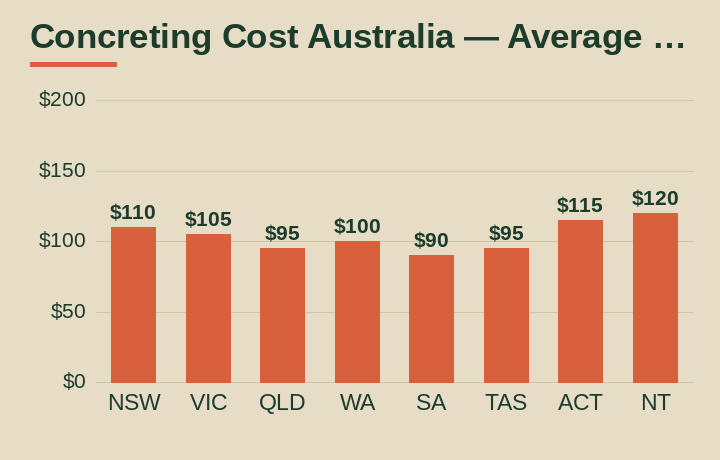
| State | Average Cost | Typical Range per m² |
|---|---|---|
| NSW | $110 | $80 – $155 |
| VIC | $105 | $75 – $145 |
| QLD | $95 | $70 – $135 |
| WA | $100 | $75 – $140 |
| SA | $90 | $70 – $130 |
| TAS | $95 | $75 – $135 |
| ACT | $115 | $85 – $160 |
| NT | $120 | $90 – $170 |
Get free quotes from local providers in your area. No obligation.
Why prices vary so much between quotes
Here’s where most of the difference between a $4,000 and a $6,500 driveway quote actually lives. Worth knowing before you sign anything.
Finish type. A broom finish on plain grey is the baseline at $65-$85 per m². Coloured concrete adds $25-$40. Exposed aggregate, where the top layer is washed off to reveal stones, adds $40-$70. Stencilled or stamped finishes that mimic pavers run $90-$150 per m² on top of the base. A 40m² driveway in Penrith done plain is around $3,400; the same slab in exposed aggregate is closer to $5,800.
Slab thickness and reinforcement. A standard 100mm residential driveway with SL72 mesh is the baseline. Going to 125mm for a caravan or boat parking adds about $15-$20 per m². Heavy-duty 150mm slabs with N12 reo bars (for trucks or sheds storing machinery) push the price up by $30-$45 per m². That’s an extra $1,200-$1,800 on a 40m² job.
Site access. If the concrete truck can park within 5 metres of the pour and the chute reaches, you pay base rate. Wheelbarrow access (truck on the street, pour out the back) adds $15-$25 per m² because labour blows out. Pumping concrete around a house or over a fence adds $400-$900 for the pump hire alone. Inner-Melbourne terraces in Fitzroy or Carlton-style narrow blocks routinely cop pump fees.
Excavation and prep. Removing turf, levelling, compacting base and laying road base before the pour is its own cost. Budget $25-$45 per m² for prep on a virgin site. If there’s an old slab to break up and cart away, add $20-$35 per m² in demolition. Try a self-levelling crack filler only on slabs that are otherwise sound, not as a substitute for proper prep.
Location and season. Sydney’s eastern suburbs and inner-north Melbourne consistently sit 15-25% above regional rates. A concreter in Hobart’s North or Toowoomba quotes 20% less than the same business would in Surry Hills. Pour in May-August and you’ll knock another 10-15% off because the summer rush has ended.
Plain vs decorative finishes side by side
This is the table that decides most projects. The trade-off isn’t just the upfront cost, it’s how the surface ages and what it needs from you in year five.
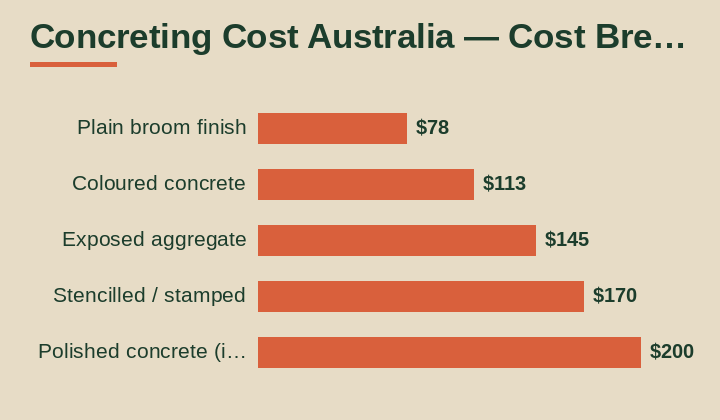
| Finish | Cost per m² | Lifespan | Maintenance |
|---|---|---|---|
| Plain broom finish | $65 – $90 | 20-25 yrs | Seal every 5 yrs |
| Coloured concrete | $95 – $130 | 20-25 yrs | Reseal yearly to keep colour |
| Exposed aggregate | $120 – $170 | 30+ yrs | Seal every 3-4 yrs |
| Stencilled / stamped | $140 – $200 | 15-20 yrs | Reseal every 2 yrs |
| Polished concrete (interior) | $150 – $250 | 30+ yrs | Low, occasional buff |
Exposed aggregate is the sweet spot for most driveways. Higher upfront, but the longer lifespan and ability to hide oil stains make it work out cheaper over 20 years than constantly resealing a coloured slab.
A real example: 60m² driveway in suburban Brisbane
For this guide I priced a hypothetical typical job, a 60m² driveway replacement in a Brisbane suburb like Carindale, single-storey home, normal truck access. Quotes from three concreters in 2026 came back at $5,200, $5,900 and $7,400 for the same brief: 100mm slab, SL72 mesh, plain broom finish, demo of the old slab included.
The $7,400 quote bundled in a 5-year workmanship warranty and used a higher-grade 32MPa concrete instead of the standard 25MPa. The cheapest didn’t include sealing. The middle quote ($5,900) was the realistic market rate for the work described. That spread is normal and it’s why MoneySmart’s home services advice pushes the three-quote rule so hard.
Questions to ask before you book a concreter
What MPa grade of concrete are you using?
25MPa is the residential standard. Anything less is suspect; anything more is overkill unless you’re parking trucks. If a quote doesn’t specify the MPa, ask, it’s how some operators cut $200-$400 off a job without you noticing.
Is steel mesh included, and what gauge?
SL72 mesh is the minimum for driveways. Some quotes use SL62 (lighter) to undercut competitors, but the slab cracks faster. Listen for a clear answer with the product code, not just “yes there’s reo”.
Who handles the council crossover approval?
If your driveway meets the kerb, that section is council land and needs a separate crossover permit ($150-$600 depending on council). Some concreters lodge it for you, others leave it on your plate. Clarify before the pour, not after.
What’s your weather contingency?
Pouring on a 38°C day or before rain is a disaster, the surface goes patchy or washes out. A good concreter will reschedule. Ask what their policy is so you’re not stuck arguing on the day.
Is the price fixed or estimated?
A fixed written quote protects you from “unforeseen” charges mid-job. Estimates can drift by 15-20%. For anything over $3,000, push for fixed.
Does the price include sealing?
Sealing adds $8-$15 per m². Some quotes include it, most don’t. A 50m² driveway unsealed costs you $400-$750 extra later if you want it protected, and you should.
FAQ
How much does concreting cost in Australia per square metre in 2026?
Plain concrete is $65-$90 per m² supplied and laid. Coloured runs $95-$130. Exposed aggregate sits at $120-$170. Decorative stamped finishes hit $200 per m² in premium metro suburbs.
Is it cheaper to lay pavers or concrete?
Pavers cost $80-$160 per m² installed, so they’re often line-ball with mid-range concrete. Concrete wins on longevity and low maintenance; pavers win on repairability when something cracks.
How long does a concrete driveway last?
Properly poured and sealed, 25-40 years. The killers are tree roots underneath, poor base prep, and skipping the sealer for the first 10 years.
Can I pour concrete myself to save money?
For small slabs under 5m², yes, you can save 40-50%. Ordering direct from a batching plant and using a concrete sealer after curing is realistic DIY. Larger jobs need professional finishing or you’ll regret it within a year.
Do concreters in Australia provide warranties?
Most offer 5-7 year workmanship warranties on cracking and surface defects, separately from the concrete supplier’s product warranty. Get it in writing.
People Also Ask About Concreting Cost Australia
What’s the cheapest concrete finish in Australia?
Plain grey with a broom finish is the cheapest at around $65-$85 per m². It’s also the most slip-resistant, which is why councils use it for footpaths and pool surrounds.
How thick should a concrete driveway be in Australia?
Residential driveways need a minimum 100mm thickness with SL72 steel mesh reinforcement. If you’ll park a caravan, boat trailer or heavy 4WD, bump it up to 125mm for the extra load.
Can you pour concrete over an existing driveway?
Yes, it’s called an overlay and costs $40-$70 per m², about half the price of a full replacement. The catch is that the existing slab must be structurally sound, or any cracks will telegraph straight through the new surface within a year or two.
How much does a concrete slab cost for a shed in Australia?
A 6m x 4m shed slab (24m²) runs $2,200-$3,400 supplied and laid in 2026. Add $400-$600 if you need extra excavation or a thicker 125mm pad for a workshop with heavy machinery.
Do concreters charge GST?
Any concreter turning over more than $75,000 annually must charge 10% GST. If a quote looks suspiciously cheap and the concreter is dodgy about GST, that’s worth questioning. Fair Work Ombudsman resources can help if you suspect something is off.
How to bring the cost down without cutting corners
- Get three written, itemised quotes. Same brief, same finish, same thickness. Differences of $1,500+ are normal and reveal who’s padding.
- Pour in autumn or winter. May to August is 15-25% cheaper than summer. Concreters chasing work will sharpen the pencil.
- Handle demolition and rubbish yourself. A jackhammer hire from any major hire shop is $90 a day. Save $400-$900.
- Skip the decorative finish on the parts no-one sees. Driveway in exposed aggregate, back slab plain. Saves $1,000+ on a typical job.
- Combine multiple slabs in one pour. Driveway plus garden path plus shed pad in one visit saves $600-$1,000 in setup and delivery fees.
- Order materials direct if DIYing. Cut out the middleman markup of 20-30%. Compare a few suppliers via Finder’s home improvement comparisons for context.
For a useful sanity check on quotes, Choice Australia publishes consumer guides on home services pricing that confirm the three-quote rule isn’t optional, it’s the difference between paying market rate and paying tradie tax.
Related Cost Guides
Recommended Products for Concreting Cost Australia
If you’re tackling this yourself, here are some products from Amazon Australia that can help:
The bottom line on concreting cost australia is that the spread between cheapest and most expensive quote isn’t random, it reflects real differences in slab thickness, concrete grade, finish complexity and warranty. Get three quotes, ask the questions above, and don’t let “it’s just concrete” lull you into accepting the first number. A 40m² driveway done properly should last you 30 years. That’s worth spending an extra week to get right.
This guide contains affiliate links. We may earn a small commission from qualifying purchases at no extra cost to you.