
Building inspection cost australia ranges from $400 to $900 for a standard pre-purchase report on a 3-4 bedroom home, with combined building and pest inspections running $550 to $1,100. When I researched current prices across capital city inspectors for this guide, the gap between the cheapest and dearest quote on the same property was often $300 or more. That’s a meaningful difference for what’s supposed to be a commodity service.
Building inspection cost australia typically runs $400 to $900 for a standard pre-purchase report on a 3-4 bedroom home. Combined building and pest inspections cost $550-$1,100. Larger homes, rural locations and same-day turnaround all push the price up.
Here’s the thing though. Cheap isn’t always good value, and expensive doesn’t always mean thorough. Choice Australia has flagged repeatedly that report quality varies wildly between inspectors, and the consumer guidance on MoneySmart’s home buying pages recommends checking credentials before price. Below is what you’ll actually pay in 2026, what’s included, and where the real money savings (or losses) happen.
What you’ll typically pay across Australia
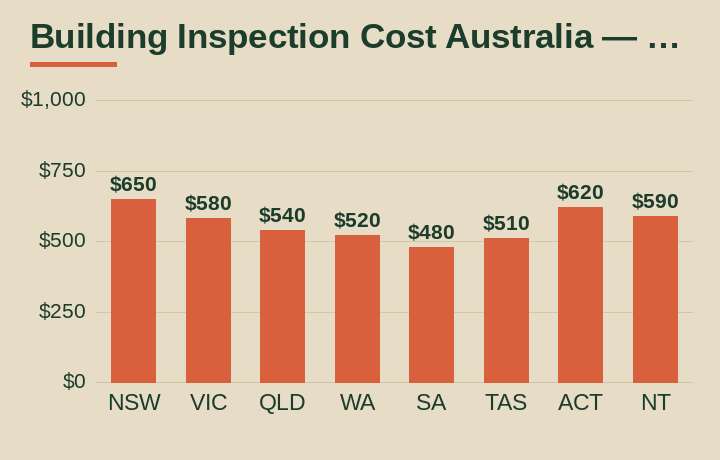
Prices below reflect a standard pre-purchase inspection on a 3-bedroom freestanding home, written report included. Combined building and pest inspections sit roughly 30-40% higher.
| State | Average Cost | Typical Range |
|---|---|---|
| NSW | $650 | $500 – $900 |
| VIC | $580 | $450 – $800 |
| QLD | $540 | $420 – $750 |
| WA | $520 | $400 – $720 |
| SA | $480 | $380 – $680 |
| TAS | $510 | $400 – $700 |
| ACT | $620 | $480 – $850 |
| NT | $590 | $450 – $800 |
Get free quotes from local providers in your area. No obligation.
Sydney and Canberra sit at the top, which tracks with everything else property-related in those markets. Adelaide and Perth remain noticeably cheaper. Regional inspections often carry a travel surcharge of $80-$200 on top.
A real example: Sarah in Newtown, Sydney
Sarah was buying a 1920s two-bedroom terrace in Newtown for $1.3M. She got three quotes: $480 from a one-man operator, $680 from a mid-tier firm, and $950 from a premium inspector with engineering credentials. She went with the $680 option.
The report flagged $42,000 of issues, rising damp in the front wall, an unpermitted bathroom addition, and dodgy electrical in the kitchen. She negotiated $35,000 off the purchase price. The $680 paid for itself fifty-one times over. That’s the case for not cheaping out, in one paragraph.
Inspection types and what they cost
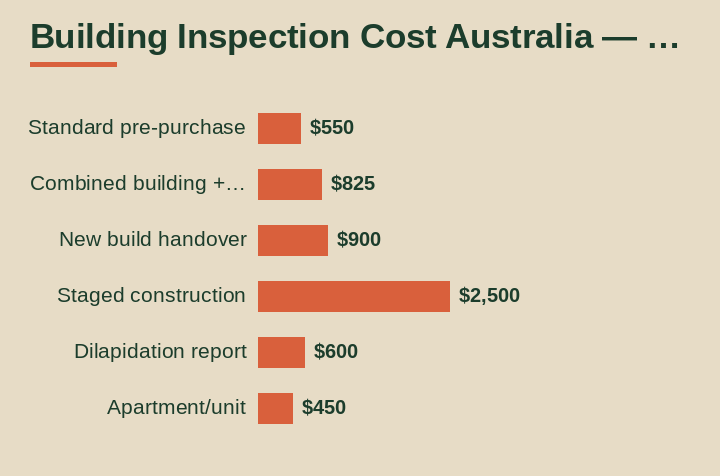
Not every inspection is the same product, and the price differences below reflect genuinely different scopes. Don’t compare apples to oranges when you’re getting quotes.
| Inspection Type | Typical Cost | What’s Included |
|---|---|---|
| Standard pre-purchase | $400 – $700 | Visual structural, roof, interior, exterior, drainage |
| Combined building + pest | $550 – $1,100 | Standard inspection plus termite/timber pest report |
| New build handover | $600 – $1,200 | Defect list before final payment to builder |
| Staged construction | $1,500 – $3,500 | 4-6 inspections during build (slab, frame, lock-up, etc.) |
| Dilapidation report | $400 – $800 | Pre-existing condition record for neighbour disputes |
| Apartment/unit | $350 – $550 | Internal-only, often paired with strata report |
The big takeaway: staged construction inspections on a new build seem expensive at $2,500 total, but they’re spread across the build and they catch issues at the point where the builder is contractually obliged to fix them. After handover, it’s your problem.
Why prices vary so much between inspectors
Property size and age
A 1970s 4-bedroom home with a subfloor and a tiled roof takes longer than a 2018 townhouse with concrete slab and Colorbond. Expect $150-$250 more for older homes simply because there’s more to look at. Sydney’s heritage terraces routinely cost $750-$900 to inspect; a new Melbourne townhouse runs $480-$580.
Geographic location
Inner Sydney suburbs like Paddington and Surry Hills sit 25-30% above the national average. Same inspector, same scope, the postcode determines the rate. Regional travel surcharges typically kick in beyond 30km from the CBD, adding $80-$200. An inspection in Toowoomba costs less than one in Brisbane, but if your inspector drives up from Brisbane you’ll pay both.
Report turnaround time
Same-day reports cost $100-$200 more than standard 48-hour delivery. In hot auction markets where you need the report before Saturday, that premium is unavoidable. In a slower negotiation, it’s wasted money.
Inspector qualifications
A qualified building inspector with a Cert IV charges $400-$600. An inspector who’s also a structural engineer or licensed builder charges $700-$1,000. For a federation-era home with visible cracking, that engineering qualification is worth the extra $300. For a 5-year-old townhouse, probably not.
Insurance and report detail
Cheap inspectors sometimes carry minimal professional indemnity insurance and produce 12-page reports with stock-photo defects. Premium operators produce 30-50 page reports with annotated images and cost estimates. The Canstar home buyer guidance specifically calls out report detail as the key quality differentiator, and frankly, it’s the only thing that matters when you’re negotiating.
Questions to ask before you book
Do you follow AS 4349.1 standards?
This is the Australian Standard for property inspections. Any reputable inspector will say yes immediately. If they hedge or don’t know what you’re asking, walk away. It’s a baseline, not a brag.
Can I see a sample report before I book?
Quality inspectors will email you a redacted sample. Look for annotated photos, plain-English explanations and rough cost estimates for defects. If the sample is generic ticked checkboxes with no detail, your report will be too.
What’s your professional indemnity insurance coverage?
You want at least $1 million in PI cover. If the inspector misses something serious, that insurance is your only recourse. Get the policy number, not just a verbal confirmation.
Will you access the roof cavity and subfloor?
Some inspectors skip these areas citing safety. That’s where termites live and where dodgy plumbing hides. If they won’t physically enter both, they’re charging you for half a job. A quality thermal imaging camera can complement (not replace) physical access.
Are you independent of the real estate agent?
Agent-referred inspectors aren’t always biased, but they have incentive to keep deals together. Ask directly. An honest inspector will tell you who refers them.
Do you provide a written quote or hourly rate?
Always get a fixed written quote for the specific property. Hourly billing on an inspection is a red flag in this industry. The job has a defined scope and should have a defined price.
Common mistakes that cost buyers thousands
- Booking the cheapest quote without checking the sample report. A $380 report that misses $20,000 in damage is the most expensive inspection you’ll ever buy.
- Skipping the pest inspection on timber homes. Termite damage is excluded from standard building inspections. A specialist inspection approach (separate building and pest reports) typically costs the same as combined but produces better detail.
- Not attending the inspection in person. Reading “minor cracking to rear wall” tells you nothing. Standing there while the inspector explains it tells you whether to walk away.
- Forgetting to use the report in negotiations. Reports with photos and cost estimates routinely shave $5,000-$30,000 off purchase prices. You paid for the leverage, use it.
How to bring the cost down without cutting corners
The save-money plays here are about timing and bundling, not about finding the cheapest operator. A moisture meter for your own initial walk-through can also help you decide whether to spring for the premium inspection or stick with standard.
- Bundle building and pest into one visit, saves $150-$250.
- Skip same-day turnaround if you’ve got 48 hours, saves $100-$200.
- Get three quotes from independent inspectors, not agent-referred. Saves $100-$300 typically.
- Negotiate hard after the report, a detailed defect list with photos is worth $5,000-$30,000 off the purchase price.
- Ask about return-visit discounts. If this purchase falls through, many inspectors offer 15-25% off your next report within 60 days.
If you’re looking at multiple property types, you might also find our guides on how we research these prices and related home services useful for context.
Frequently Asked Questions
Is a building inspection worth the money?
Almost always, yes. Spending $500-$800 to find $30,000 in hidden structural damage before you sign contracts is one of the highest-ROI decisions in property buying. Skipping it on a unit in a well-maintained block is more defensible than skipping it on a 1970s freestanding home.
How long does a building inspection take?
Most pre-purchase inspections take 2-3 hours on site for a standard 3-4 bedroom home, plus another day or two for the written report. Combined building and pest inspections add 30-60 minutes. Larger or older homes can stretch to 4 hours.
Who pays for the building inspection, buyer or seller?
In Australia, the buyer pays for the building inspection in almost every case. The exception is a vendor inspection report, where the seller commissions a pre-listing report to share with interested buyers, but most buyers still want their own independent inspection anyway.
Can I attend the building inspection?
Yes, and you should if you can. Most inspectors welcome buyers walking through with them at the end to point out issues in person. You’ll get far more out of a 20-minute walk-through than reading a 40-page PDF cold.
Are building inspectors regulated in Australia?
Regulation varies by state. NSW, Queensland and Victoria require inspectors to hold specific qualifications and insurance, while other states have lighter requirements. Always check the inspector carries professional indemnity insurance and follows AS 4349.1 standards.
People Also Ask About Building Inspection Cost Australia
What’s the difference between a building inspection and a pest inspection?
A building inspection covers structural issues, roof, walls, plumbing visuals, drainage and safety. A pest inspection specifically looks for termites, borers and timber pests. Most buyers get them combined because the inspector needs roof and subfloor access for both anyway.
Do I need a building inspection on a brand new home?
Yes, even more so on a recent build. New build defects are extremely common in Australia, with cracking, waterproofing failures and incomplete works showing up regularly. A handover inspection before final payment is one of the cheapest forms of insurance you can buy.
How much is a building inspection on an apartment?
Apartment inspections in Australia typically cost $350-$550, cheaper than freestanding homes because there’s no roof cavity or subfloor to access. The strata report is a separate purchase, usually $250-$400, and you’ll want both before signing.
Can a building inspection cover asbestos?
Standard inspections will note suspected asbestos but won’t test it. A separate asbestos assessment costs $300-$600 and is worth considering for any home built before 1990, particularly if you’re planning renovations.
What happens if the building inspection finds major problems?
You have three realistic options: walk away (during the cooling-off period in most states), negotiate a price reduction with the seller, or request specific repairs as a condition of settlement. A detailed report with cost estimates strengthens any negotiation.
Related Cost Guides
Recommended Products for Building Inspection Cost Australia
If you’re tackling this yourself, here are some products from Amazon Australia that can help:
The honest summary on building inspection cost australia: budget $500-$800 for a standard combined report on a metro home, and treat that money as the cheapest insurance you’ll buy in the entire purchase process. Don’t pick the cheapest inspector, don’t pick the one your agent recommends, and don’t skip attending in person. Get the right report and the price tag pays itself back the moment you sit down to negotiate.
This guide contains affiliate links. We may earn a small commission from qualifying purchases at no extra cost to you.